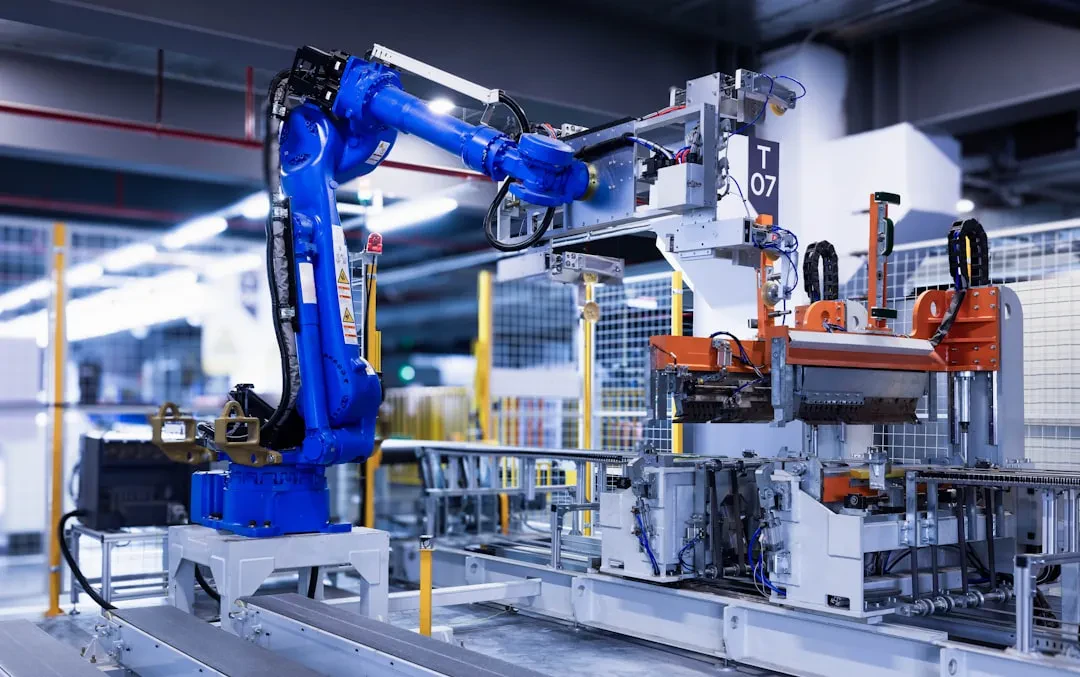
The manufacturing industry is investing in artificial intelligence at an unprecedented pace, but the ability to translate these investments into concrete results is lagging behind. Recent research shows that approximately 78% of reported barriers to AI implementation are workforce-related. This gap between access to technology and the capacity to use it consistently is becoming the true bottleneck for digital transformation.
Predictive maintenance is one of the areas where AI has shown the most immediate potential. Companies have long absorbed the costs of reactive maintenance, such as unplanned stops, overtime, and expedited parts. Now that AI has moved from speculative to deployable, the business case makes itself. However, the reality on the ground tells a different story.
The first wave proved the tools, not the operating model
Manufacturers are investing in AI to improve productivity, yet many still carry behaviors that predictive maintenance was meant to reduce. Research indicates that predictive maintenance adoption has more than doubled year over year, while reactive maintenance remained flat. Proactive maintenance has also lost ground. This means new methods are entering the plant but not fully replacing old ones, creating a dual-mode operation.
Sponsored Protocol
This should not be read as failure. Plants moved for practical reasons, and early pilots gave teams useful proof. A model can work well on a known asset with a focused team. The harder test comes when that model has to support decisions across shifts, sites, and varying levels of experience. That is where the first wave exposed the next problem. Technology can move quickly into the budget, but work habits, trust, decision rights, and frontline confidence take longer to change.
AI investment shifts toward operational priorities
Budget data confirms that leaders are not walking away from AI; they are becoming more selective about where it has to prove itself. Investment is moving away from exploratory AI and toward operational priorities, including cybersecurity, data management, Generative AI, and Industrial AI. This shift reflects a more practical view of digital maturity, aiming to make AI work where the cost of delay, downtime, and poor data shows up quickly.
It also reframes expectations around Industry 5.0. As industrial technology moves from Industry 4.0's automation-led model toward a more human-in-the-loop approach, leaders appear to be recalibrating the timeline, with 40% now expecting a one- to four-year journey.
Sponsored Protocol
Where the model stops and the supervisor starts
It is easy to misread the 78% workforce-barrier figure as a labor shortage story. In reality, it points to a lack of expertise, knowledge shortages, skilled labor gaps, and broader workforce capability deficits. These four categories describe something harder to fix than a recruitment problem. They describe an organization's capacity to absorb a different way of working. Researchers Cohen and Levinthal gave that capacity a name, absorptive capacity. In plain English, it is how quickly a business can recognize useful new knowledge, absorb it, and convert it into practical output.
In a maintenance context, that output is a decision made under real operating conditions. A night-shift supervisor must weigh whether a current anomaly justifies an intervention, whether it can wait until the next planned stop, or whether the risk has already crossed a line. A model can flag the anomaly, but it cannot make that call. The UK Government's AI Skills for the UK Workforce report identifies the gap in concrete terms, highlighting the ability to interpret AI outputs, adapt workflows, and communicate changes to frontline teams as key competencies.
Sponsored Protocol
Investing for predictive, paying for reactive
The commercial consequence is visible in the lag between spending and return. Predictive adoption is rising, more capital is allocated, yet the reactive baseline has not moved. Many plants are running two modes of operation at once, investing for data-driven execution while still losing time to avoidable firefighting. Siemens' 2024 True Cost of Downtime research puts unplanned downtime losses for the world's 500 biggest companies at $1.4 trillion annually, 11% of their total revenues. This figure reflects what happens when the shift from reactive to predictive is incomplete. The investment is there, but daily execution has not fully followed. When that gap persists, ROI arrives slowly and unevenly, timelines extend, and confidence weakens.
Where the return is earned
The discipline applied to tools and platforms now needs to apply to the people and routines around them. For many organizations, that is where the return is left on the table. Leaders should start with the parts of the operation where capability is most fragile. Which assets still depend on one or two experienced technicians to interpret what is happening? Which work histories are too thin to support the next diagnosis? Which alerts trigger confident action, and which sit in limbo until the right person is on shift? These questions reveal whether predictive maintenance has become part of execution or is still sitting on top of reactive habits.
Sponsored Protocol
Capturing the know-how that still lives in people's heads before it walks out the door is crucial. Making work histories complete enough to help the next technician and training operators to understand what a predictive alert is telling them are essential steps. Shaping workflows so acting on insight becomes the normal path is key. Connected reliability supports this execution when it stays close to the work, linking asset data, maintenance history, and frontline judgment to enable repeatable decisions.
Our research shows that nearly half of respondents plan to advance connected reliability initiatives within the next 12 months, treating reliability as the practical bridge between near-term operational needs and long-term ambitions. The call for manufacturing leaders is straightforward, audit capability with the same seriousness as technology spend. Ask not only what AI has been deployed, but who can act on it, where decisions slow down, what knowledge is undocumented, and which workflows still pull teams back into reactive work. An example of AI entering the industry is visible in streaming, as with Peacock's transformation of live sports. Tech leadership is also evolving, as shown by the recent change at the helm of Apple. AI is even finding innovative uses in medicine, with Apple Vision Pro used in the first hip arthroscopy.
Sponsored Protocol
According to a report from TechRadar Pro, the real challenge is closing the gap between technology adoption and the ability to use it. Only with parallel investment in people and processes can industrial AI deliver its promise.
Source: https://www.techradar.com/pro/why-industrial-ai-is-adopting-faster-than-its-working